
EU knowledge is not one subject.
It is a connected system of treaties, institutions, procedures, competences, policies, legal principles and political choices. Candidates are often expected to understand how these pieces work together—not merely remember isolated dates or institutional names.
That is why we rebuilt the EPSOHQ EU Knowledge Database from the ground up.
The new database is a structured learning programme covering the foundations of European integration, the EU legal order, institutions, decision-making, public money, the internal market, major policy fields, justice and external action.
It is now available in English, French, Italian, Spanish and Bulgarian.
This is not a library of long videos. It is a rich-text study environment designed for focused reading, quick revision and active recall.
What is included
| Resource | Coverage |
|---|---|
| Structured chapters | 22 |
| Study tracks | 6 |
| Rich-text lessons | 94 |
| Learning objectives | 210 |
| Retrieval checks | 94 |
| Mapped source references | 264 |
| Diagrams and decision maps | 23 |
| Complete languages | 5 |
| Estimated study time | About 13 hours 40 minutes |
Every chapter has a defined purpose. Every lesson connects to learning objectives, prerequisite knowledge, retrieval questions and official sources.
The result is a guided course rather than an endless collection of facts.
Six tracks through the EU system
The 22 chapters are organised into six study tracks.
1. Foundations of the Union
The first track establishes the legal and historical framework needed for everything that follows.
- How the Union Was Built
- The Legal Architecture of the EU
- Values, Objectives and Fundamental Rights
You will trace the development of European integration, compare the major treaties, distinguish primary and secondary law, classify Union competences and understand how EU values and fundamental rights operate.
Specialised visuals include an integration timeline, a legal-order map and a rule-of-law decision tree.

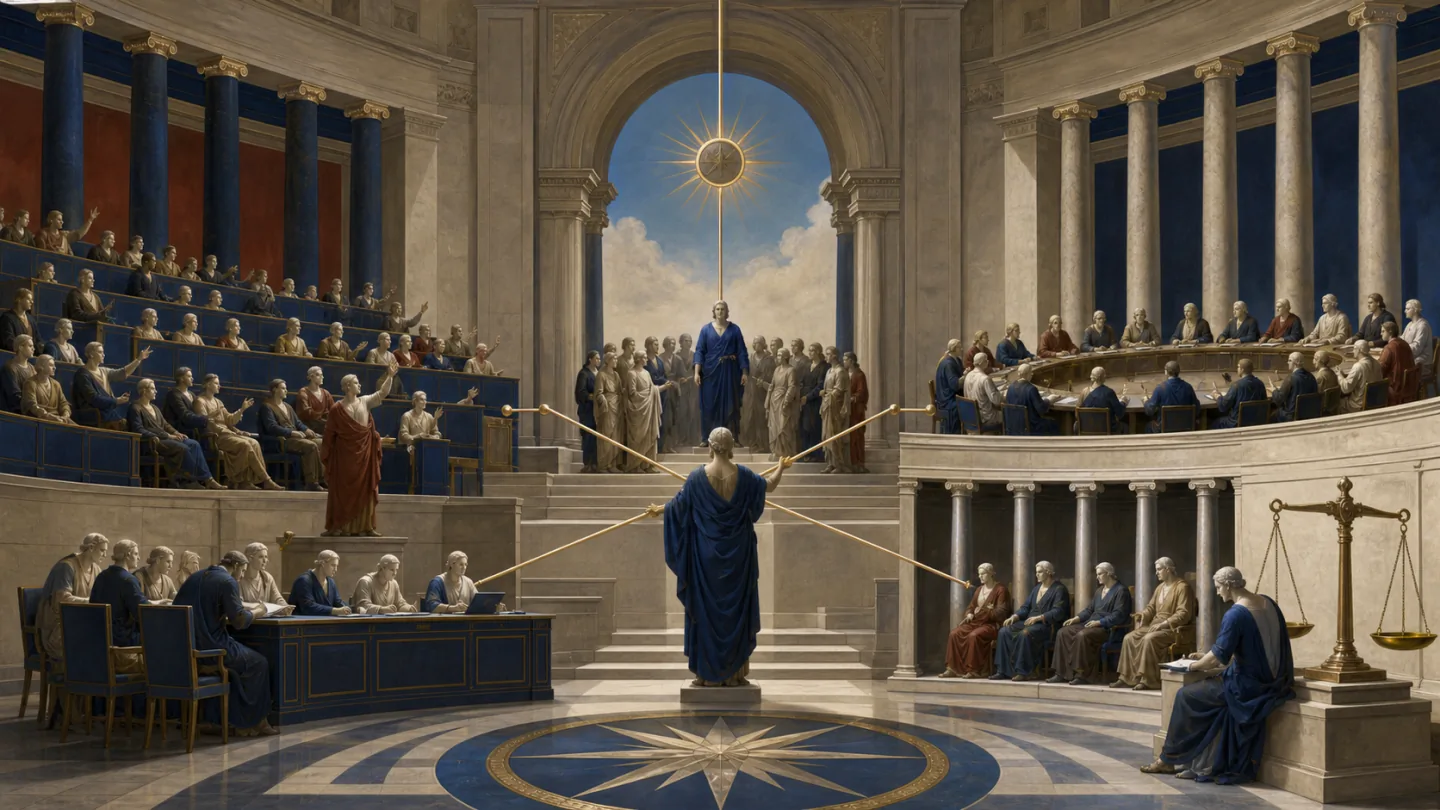
2. Institutions and Accountability
This track explains who does what—and who answers to whom.
- The European Parliament
- Two Councils
- The European Commission
- The Court of Justice of the European Union
- Other EU Bodies
Chapter 18: EU Agencies, Delegation and Accountability
The lessons distinguish the European Council from the Council of the European Union, follow the Commission’s political and administrative roles, map Parliament’s legislative and supervisory powers, and explain judicial review by the Court of Justice.
The agencies chapter goes further. It examines delegated powers, institutional balance, accountability and the limits placed on specialised EU bodies.
3. Decision-Making and Public Money
This track follows EU action from political idea to legal and financial implementation.
- Chapter 9: How EU Law Is Made
- Chapter 10: The EU Budget and the Multiannual Financial Framework
- Chapter 11: EU Citizenship, Democracy and Languages
- Chapter 17: Reforms, Challenges and Who Is in Charge
Chapter 9 contains dedicated diagrams for the ordinary legislative procedure and the differences between regulations, directives, decisions, recommendations and opinions.
The budget chapter connects annual budgeting with the Multiannual Financial Framework. The citizenship chapter covers democratic participation, language rights and the relationship between national and Union citizenship.

4. Market, Money and Competition
This track explains the rules underlying economic integration.
- Chapter 12: The Internal Market and the Four Freedoms
- Chapter 13: Economic and Monetary Union
- Chapter 19: Competition Law, State Aid and Merger Control
You will compare the free movement of goods, workers, services and capital; distinguish the euro area from the wider EU; understand the roles of the European Central Bank and national institutions; and separate antitrust, merger-control and State-aid procedures.
The focus is not only on definitions. Lessons ask which rule, institution or procedure applies to a practical scenario.

5. Policy Engine Rooms
This track covers major policy fields where legal competence, financing and political priorities meet.
- Chapter 14: Big-Ticket Policies
- Chapter 20: The Social Union
- Chapter 21: Green Transition and Industrial Decarbonisation
- Chapter 22: Digital and Competitive Europe
The chapters connect cohesion policy, agriculture, environmental law, climate action, employment, health, skills, industrial decarbonisation, digital regulation and European competitiveness.
Policy-heavy chapters are treated as higher-volatility material. This allows changing legislation and priorities to be reviewed more frequently than stable treaty principles.

6. Justice, Borders and External Action
The final track examines EU action across borders and beyond the Union.
- Chapter 15: The Area of Freedom, Security and Justice
- Chapter 16: External Relations
It covers Schengen, asylum, migration, judicial cooperation, police cooperation, common foreign and security policy, trade, enlargement, neighbourhood policy, sanctions, development and humanitarian action.
The lessons emphasise divisions of responsibility. Political visibility does not always equal formal legal competence, and external action often involves different procedures depending on the policy field.

Built for active learning
Reading can create a false feeling of mastery. A paragraph may look familiar even when you cannot explain or apply it.
The new reader addresses this in several ways.
Clear objectives
Every lesson begins with a defined learning target.
You know whether you are expected to explain a concept, distinguish similar institutions, apply a legal rule or identify the correct procedure.
Prerequisite paths
EU topics depend on one another.
You cannot fully understand State aid without understanding the internal market. You cannot follow the ordinary legislative procedure without knowing the roles of Parliament, Council and Commission.
Prerequisites make these relationships visible and help you study in a sensible order.
Retrieval checks
Every lesson ends with a focused question.
The check is tied to the lesson objective and includes an explanation. This helps expose confusion immediately, before it becomes part of your long-term revision.
These checks are learning tools. They are separate from timed EPSO simulations and should be used to confirm understanding after each lesson.
Diagrams and decision maps
Some EU processes are easier to understand visually.
The reader therefore includes timelines, institutional maps, decision trees, procedure diagrams, act comparisons and chapter-level concept maps.
These illustrations do not replace the text. They compress relationships so that you can reconstruct the process during revision.
Rich text instead of video dependency
There are no hours of compulsory video to sit through.
Lessons use structured rich text that can be scanned, searched, reread and revisited at your own pace. Diagrams appear where they add clarity. Important distinctions remain visible on the page.
This format also works better when you have ten minutes to revise one procedure rather than an hour to replay a recording.
Sources are part of the lesson
EU knowledge changes at different speeds.
Treaty provisions are relatively stable. Institutional compositions, policy programmes, budget figures and current initiatives can change much faster.
The database therefore maps lessons and retrieval checks to official source references. These include EUR-Lex, the Treaties, institutional websites and official EU policy material.
Sources are presented with the content instead of being hidden in a general bibliography. This lets you:
- verify a rule in its official context;
- distinguish primary law from institutional guidance;
- continue reading beyond the lesson;
- identify material that may require later updating;
- avoid relying on unsupported summaries.
Important: EPSOHQ is not an EU institution, and the database is not an official EU or EPSO publication. Its role is to organise official material into a practical study structure.
Complete learning content in five languages
The rebuild is available in English, French, Italian, Spanish and Bulgarian.
Localization covers more than navigation labels.
Lesson bodies, objectives, retrieval questions, answer explanations, source presentation and specialised diagrams have been localized across the complete released programme.
This matters because candidates should be able to study complicated institutional and legal relationships in the language they understand most precisely.
How to use the database
Do not try to finish all 22 chapters in one uninterrupted pass.
Use a three-stage approach.
First pass: build the map
Start with the Foundations track.
Move through each chapter without trying to memorise every detail. Focus on the relationship between treaties, competences, institutions and legal acts.
Complete each retrieval check before reading its explanation.
Second pass: connect institutions to procedures
Study Parliament, the two Councils, the Commission and the Court alongside Chapter 9.
Ask the same questions repeatedly:
- Who initiates?
- Who decides?
- Who supervises?
- Which legal basis applies?
- Which institution can challenge the decision?
- Is the procedure legislative, executive, budgetary or judicial?
This produces a working institutional model instead of four disconnected lists.
Third pass: apply the framework to policies
Move into the market, budget, competition, social, climate, digital, justice and external-action chapters.
For every policy, identify the competence, institutions, legal instruments, financing method and accountability mechanism.
Return to lessons where retrieval checks exposed uncertainty.
Start with the foundations
The first three chapters provide the foundation for the complete programme:
- How the Union Was Built
- The Legal Architecture of the EU
- Values, Objectives and Fundamental Rights
Open the EU Knowledge Database, choose your language and begin with Chapter 1.
If you already have an EPSOHQ account, sign in to access the new rich-text reader across all 22 released chapters.
EU knowledge becomes manageable when it stops looking like hundreds of unrelated facts and starts looking like one connected system.
That connected system is what the new database was built to teach.
Want structured preparation?
Our training programs cover exactly the skills and techniques described in this article.
Start your preparation